Is Claudish becoming the dialect of coding agents?
Claude Code and Codex keep reaching for the same unusually precise vocabulary. I checked a week of local sessions to see whether the pattern was real.
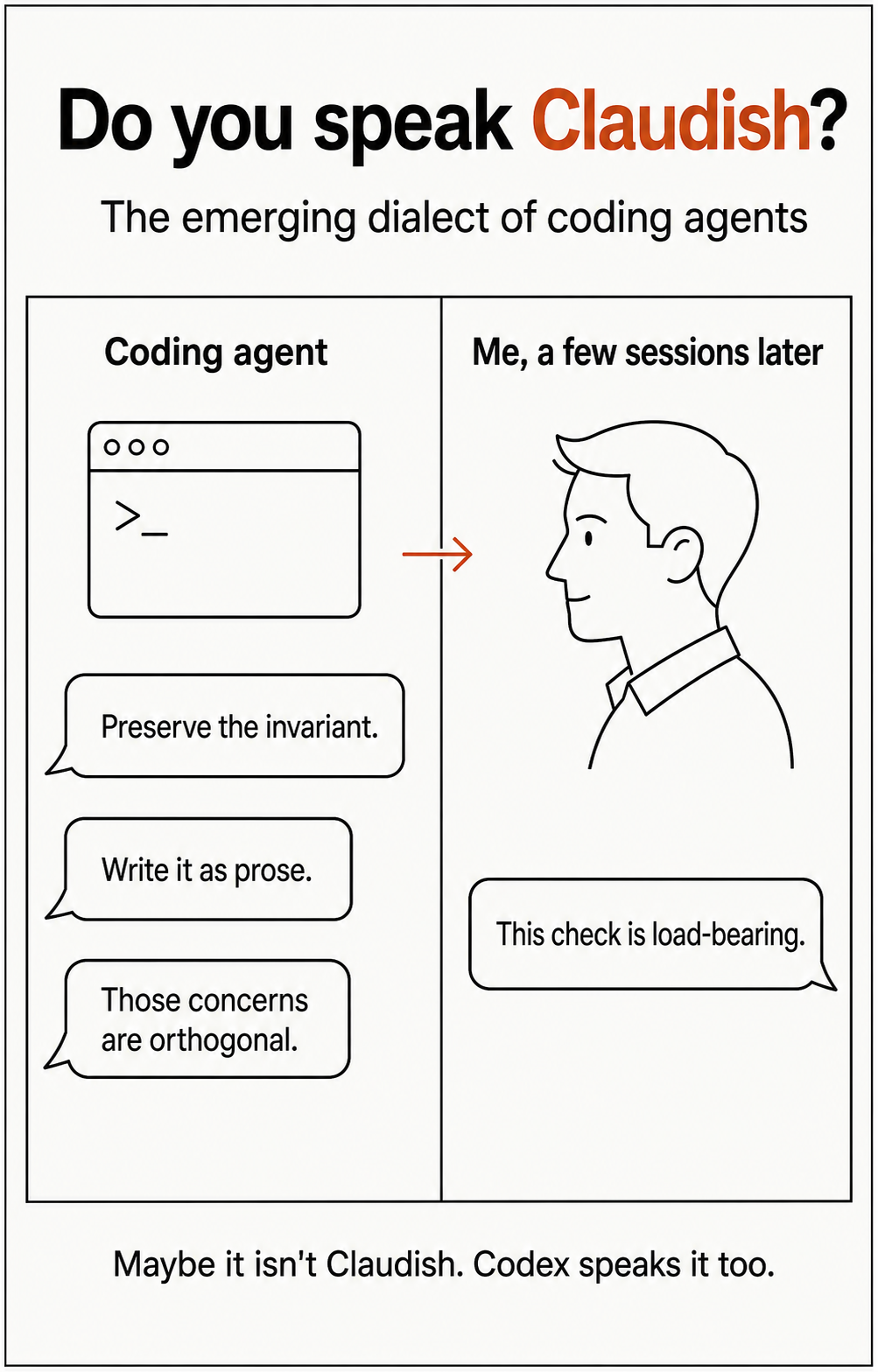
Recently, Claude Code has been talking to me like a principal engineer who swallowed a philosophy dictionary.
“That check is load-bearing.”
“This is a tautology.”
“Preserve the invariant.”
“Those concerns are orthogonal.”
Every few sessions, I stop to look up another word.
I started calling the pattern “Claudish” as a joke. Then I noticed Codex using much of the same vocabulary. That made the question more interesting. Maybe this is not one model’s verbal habit. Maybe coding agents are developing a shared working dialect.
I checked a week of local sessions
I scanned the seven days ending 29 August 2026 on my own machine:
- 44 main Claude Code session files
- 92 Codex session files
- 2,089 Claude assistant text blocks
- 747 Codex assistant text blocks
That produced 2,836 blocks of assistant-written prose.
The scan excluded my prompts, tool output, code, and Claude subagent histories. I was looking only at language the assistants produced while explaining work, reviewing decisions, or describing system behaviour.
This is a local sample, not a universal study of every model or every developer. But the pattern was strong enough to stop feeling anecdotal.
The vocabulary crosses disciplines
Some of the terms come directly from software engineering. Others come from control systems, security, audit, UX, formal reasoning, and ordinary literary language.
| Term | What the agent usually means |
|---|---|
| Load-bearing | A small part that the larger result depends on |
| Tautology | A claim repeated without adding information |
| Prose | Ordinary written language rather than code or structured data |
| Provenance | Where a claim, value, or artifact came from |
| Hysteresis | Current behaviour depends partly on the previous state |
| Invariant | A condition that must remain true through a change |
| Idempotent | Safe to repeat without creating another effect |
| Orthogonal | Independent from another concern or decision |
| Canonical | The authoritative version or representation |
| Affordance | A cue that suggests what action is available |
| Attestation | Evidence or a declaration that something was checked |
| Fail-closed | Stop or deny when verification is unavailable |
| Byte-identical | Exactly the same at the binary level |
| Permission laundering | Routing a denied action through another agent or session |
| Last-known-good | A previous state known to work and safe to restore |
Across inflected forms in the sample, prose appeared 83 times, provenance 70 times, invariant 34 times, and hysteresis 24 times. Load-bearing appeared 15 times and tautology 10.
The words are not equally exotic. A developer may use idempotent every week. A designer may use affordance without noticing it. Someone working in distributed systems may find hysteresis ordinary. What feels unusual is seeing one assistant move fluently among all of them inside the same coding session.
Why does “prose” appear so often?
Prose was the term that surprised me most by frequency.
In everyday conversation, we rarely need to distinguish prose from everything else. In a coding harness, the distinction matters constantly. An agent moves among source code, shell commands, JSON, Markdown tables, configuration, logs, and natural-language explanation. “Write this as prose” is a compact way to say: use ordinary sentences, not a schema, list, table, or code block.
The word is not decorative. It marks an output mode.
That is true of much of this dialect. The terms survive because they compress decisions that would otherwise take a paragraph to explain.
Load-bearing says that removing one apparently minor line will collapse a larger guarantee. Invariant names what must remain true while the implementation changes. Provenance asks where evidence came from. Fail-closed specifies what the system should do when it cannot verify safety.
The vocabulary sounds academic until you try to replace each term with plain language every time. Then its operational value becomes obvious.
A dialect forms around repeated work
A dialect is not only a list of unusual words. It is a shared way of deciding which distinctions matter.
Coding agents work inside environments where they must constantly separate:
- Guidance from enforcement
- Claims from evidence
- Current state from previous state
- Reversible actions from irreversible ones
- Human-readable explanation from machine-readable structure
- The authoritative artifact from a copy
That environment rewards precise labels. Models have encountered these labels across technical writing, documentation, code review, and security guidance. Coding-agent harnesses then give the words a place to recur in ordinary work.
The result is a blended register: part senior engineering review, part control theory, part audit report, part UX critique.
The language flows back to the human
The stranger part is not that the models use these words.
It is that I have started using some of them back.
After seeing load-bearing applied repeatedly to a validation step, I reach for it faster when describing a requirement that looks small but carries the whole guarantee. Provenance has become the natural question when an agent produces a confident claim. Canonical is useful when several generated artifacts compete to be the source of truth.
This is not automatically good. Precise language can sharpen thinking, but jargon can also hide weak reasoning. An agent calling something an invariant does not make it one. The condition still needs to be explicit and verifiable. A fancy term should reduce ambiguity, not replace evidence.
That may be the practical test for Claudish:
Does the word make the next decision clearer?
If yes, keep it. If it merely makes the explanation sound more authoritative, translate it back into ordinary language.
Maybe “Claudish” is the wrong name. Codex speaks it too. This may simply be the emerging dialect of agent-assisted software work.
Either way, every coding session now seems to be half engineering and half vocabulary lesson.